
💧 Quick heads up: This isn’t a complicated job — you don’t need any tools. But knowing where these valves are could genuinely save your home one day.
Here’s something we see all the time — a pipe starts leaking, water’s going everywhere, and the homeowner is running around the house with no idea how to turn it off. It’s stressful, and it’s totally avoidable.
Isolation valves are the small valves tucked away under your sinks, behind your toilet, and beside your appliances. Each one lets you shut off water to a single fixture without cutting off the whole house. Find them now, while everything’s dry and calm — not when something’s gone wrong.
Here’s how to do a walk-through of your home. Grab your phone torch and let’s go room by room.
—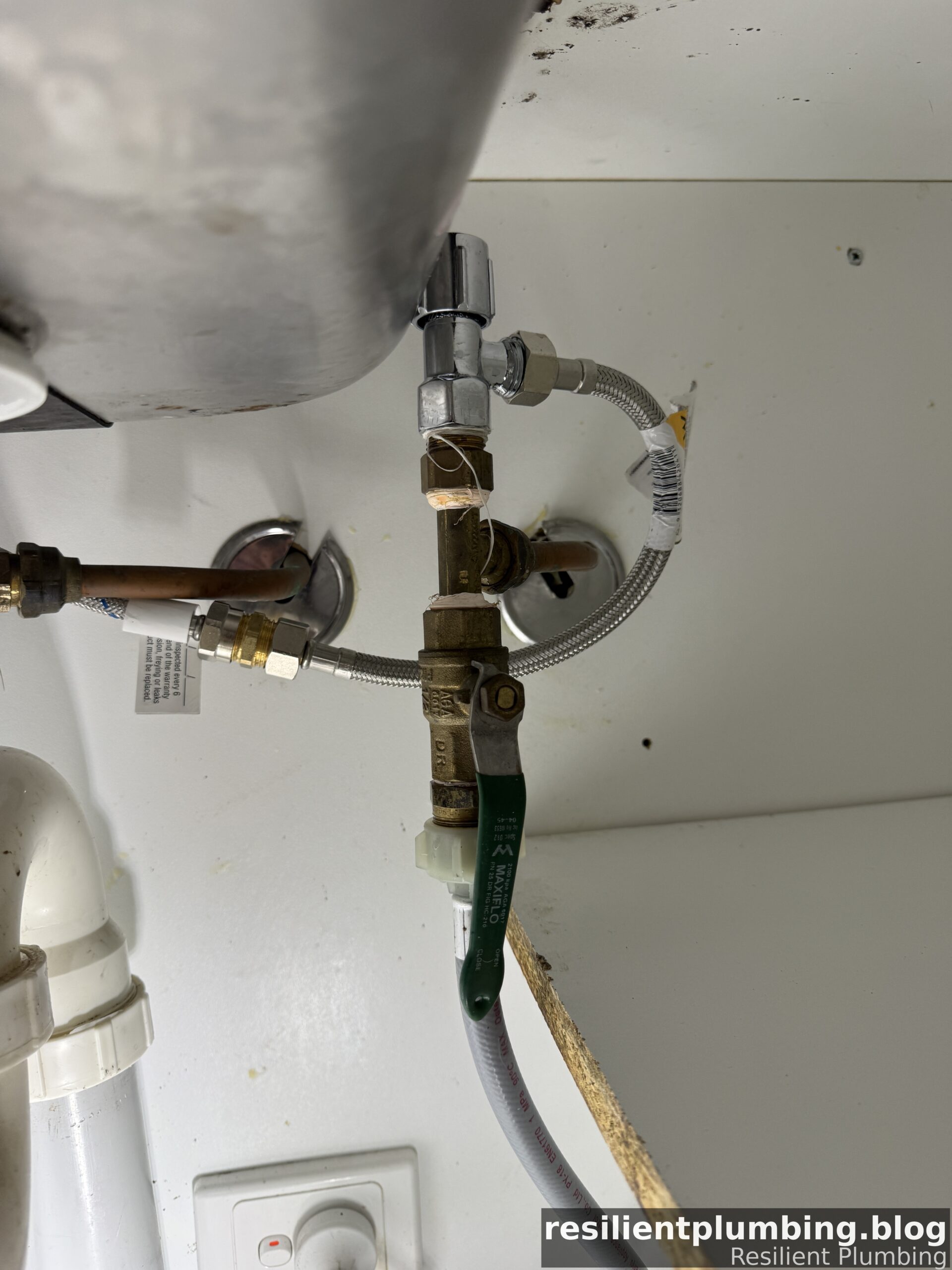
This is what a typical isolation valve setup looks like under a kitchen sink cabinet — the chrome handle on top is the valve itself, connected to the flexible hose running up to the tap.
🚿 Bathroom
Start here — bathrooms usually have the most valves in the house.
🚽 Toilet
Look behind or beside the base of the cistern. There’s usually a small oval handle on the pipe coming out of the wall. Turn it clockwise and the water to the toilet stops — everything else in the house keeps running.
🪥 Vanity / Basin
Open the cabinet under the basin. You’ll see two flexible hoses going up to the tap — one hot, one cold. Each should have a valve at the bottom where it meets the wall. Both turn clockwise to shut off.
🚿 Shower
Most showers don’t have their own isolation valve — they’re fed from the main hot and cold lines. If you need to isolate a shower, you’ll usually need to turn off a zone valve or the mains.
🍳 Kitchen
🚰 Kitchen Sink
Open the cabinet under the sink. Two flexible hoses connect to the mixer tap from below — each should have a valve. Hot on the left, cold on the right, as a general rule.
🍽️ Dishwasher
Check under the sink or behind the kickplate at the base of the dishwasher. There’ll be a cold water valve — sometimes it branches off the sink’s cold line, sometimes it’s separate.
💧 Fridge / Filtered Water
If you’ve got a fridge with water or a filtered water unit, there’s usually a small quarter-turn valve tapped into the cold line under the sink. Easy to miss — look carefully.
🧺 Laundry
👕 Washing Machine
Behind or beside the machine, you’ll usually find two wall-mounted taps — red for hot, blue for cold. These should be easy to reach. If they’re buried behind the machine, that’s worth fixing.
🪣 Laundry Tub
Same deal as the bathroom basin — open the cabinet underneath and look for valves on the flexible hoses. Hot and cold, both turn clockwise.
🔥 Hot Water System
Your hot water unit will have a cold water inlet valve — it’s the pipe feeding cold water into the system. If the unit ever starts leaking, this is the one to turn off first. Gas units will also have a gas isolation valve nearby.
🏠 Main Water Metre
This one’s outside — usually in a small underground box near the front boundary of your property, sometimes in the driveway or garden. It’s your master off switch for the whole house. Make sure everyone in your household knows where it is, not just you.
⚠️ One thing to watch out for
In a lot of Melbourne homes — especially those built before 2000 — some fixtures just don’t have isolation valves at all. If you find one missing, it’s worth getting it sorted before you need it. It’s a quick job, and we carry valves on every van.
📋 Make a Simple Note
Once you’ve done the walk-through, jot down what you found — even just a quick note on your phone. Something like:
Main metre — front garden near letterbox ✅
Kitchen sink — under cabinet, 2 valves ✅
Dishwasher — under sink, cold line ✅
Bathroom toilet — behind cistern ✅
Bathroom basin — inside vanity, 2 valves ✅
Washing machine — behind machine, red + blue ✅
Hot water unit — cold inlet valve on left side ✅
Ensuite toilet — ❌ no valve, needs one installed
Keep it on the fridge or somewhere easy to find. In an emergency you won’t want to be hunting for this information.
What if a valve is stuck?
Don’t force it. Valves that haven’t been touched in years can seize up, and forcing them risks snapping the valve or the pipe. If you find one that won’t budge, give us a call — we can replace it before it becomes a problem.
Missing a valve? We can sort it out.
If your walk-through turns up any missing or seized valves, we’re happy to take care of it. We cover Melbourne’s Eastern and South Eastern suburbs.
📞 Call 0432 704 268 Book Online